

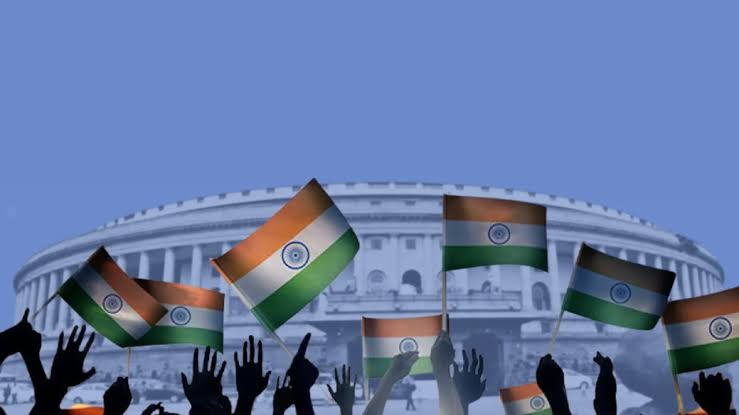

The role of the opposition in a parliamentary democracy is extremely crucial. It is the opposition that keeps the government on its toes on a day-to-day basis. It makes sure that the government works within the given boundaries and remains transparent and accountable to those who have elected it to power.
Without a credible opposition, governments tend to promote and promulgate policies that benefit the party in power alone. The opposition also helps cultivate a democratic culture of deliberation and debate, allowing diverse views to be considered and, where possible, leading to consensus.
Of course, this assumes that the opposition has sufficient strength in Parliament to pose a credible threat of toppling the government in power. To have comparable strength is the watchword. This brings us to the current situation of the opposition in India.
The Formation of I.N.D.I.A.
In India, the Indian National Developmental Inclusive Alliance (I.N.D.I.A.), a consortium of 28 parties led by the Congress, emerged as the principal opposition alliance to the NDA-led government ahead of the general election.
The first meeting of the non-BJP opposition parties was organised by Shri Nitish Kumar in Patna in June 2023, when the proposal to form an alliance of opposition parties was put on the agenda. The meeting was attended by more than 16 opposition leaders.
Their second meeting was held in Bengaluru in the middle of July of the same year. The meeting was chaired by Sonia Gandhi, wherein the proposal for such an alliance was accepted. The names of an additional ten parties were also added at this meeting. It was at this meeting that the name of the alliance was finalised as the “Indian National Developmental Inclusive Alliance (I.N.D.I.A.).” The stated purpose was to fight the next general election as a unified opposition.
In a subsequent meeting held in Mumbai in August of the same year, the leaders deliberated on major electoral issues that were likely to arise in the upcoming general elections of 2024. At the meeting, they nominated a coordination committee to coordinate the activities of the consortium.
At their next meeting, held in Delhi in December, they deliberated on acceptable seat-sharing arrangements among the participants of the alliance, which they were able to finalise successfully. They also adopted a resolution to ensure maximum use of what they called the “Voter Verifiable Paper Audit Trail” (VVPAT). They believed this would enhance people’s confidence in the electoral process.
At their last meeting, held virtually, Congress President Mallikarjun Kharge was declared the alliance’s Chairperson. It was at this meeting that Shri Nitish Kumar, the Chief Minister of Bihar, was offered the post of National Convenor, which he declined before defecting to join the National Democratic Alliance (NDA).
My purpose in giving these details about the formation of I.N.D.I.A. and its proceedings is to convey that the alliance did turn out to be a very cohesive and credible consortium of 28 political parties, confident of challenging the NDA effectively in the forthcoming elections.
Since they were fighting a common enemy, there was considerable cohesiveness within the formation. The group entered election mode with more than just the hope of wresting power from the NDA—it had the hope of actually claiming the seat of power.
While the alliance was very confident of winning the election, the public at large was somewhat sceptical that, even if it were to form the government, it might not last very long. Such a large gathering of political parties, many felt, would not be able to remain united because of the competing interests and requirements of different parties. Most people felt that the alliance, if in power, would remain in perpetual firefighting mode.
I must confess that I myself had a very similar view. Now, let us look at the results of the 2024 general elections.
The 2024 General Elections
Of the total 543 seats, the NDA secured a majority, winning 293 seats, including 240 seats won by the BJP alone. The BJP considered this a great setback, as it had been pitching for 400 seats for itself.
The opposition alliance, as a group, managed to secure 234 seats. Clearly, the alliance did not do as well as it had hoped or expected. While these represent the final results, the real story lies in the details.
Though the BJP lost 63 seats compared with the 2019 elections, its percentage of the popular vote did not change much. Its share of the popular vote in this election was 36.56 percent, compared with 37.36 percent in the 2019 elections—a loss of just 0.8 percentage points, which is negligible indeed.
Clearly, the BJP has a very loyal Hindu constituency that believes in what is commonly described as Hindutva. This group, representing more than 35 percent of the electorate, constitutes a committed vote bank for the BJP.
The defeat of regional parties such as the Rashtriya Janata Dal in Bihar and the Trinamool Congress in recent by-elections seems to have further emboldened the right wing to push further towards consolidating its position, not just in Parliament but also in the legislative assemblies.
It is also true that, because of the weak and unpredictable or uncertain position of the opposition, many parliamentarians and legislators have entered the political marketplace, offering themselves for political gain. The BJP is very active in this marketplace, being both rich and resourceful and, at the same time, very eager to acquire as many political representatives as it finds useful.
The BJP has worked ruthlessly and systematically, either by co-opting or splitting regional parties, to strengthen its position in Parliament as well as in the legislative assemblies.
One can clearly see the possibility of the end of the “secular, socialist democratic Republic”—a part of the Preamble to our Constitution—if this trend is allowed to continue unchallenged.
The State of the Opposition
The alliance of 28 parties that fought the 2024 elections together is, for all practical purposes, as good as defunct now, leaving only the Congress, which secured 21.4 percent of the vote, with its loyal voters.
The Samajwadi Party (SP), having polled 4.62 percent of the vote, will perhaps remain a long-term partner of the Congress. Nothing can be said with certainty about the other assortment of smaller parties.
The hope of having a credible opposition now rests largely with the Congress, which must rejuvenate itself and gather a larger base of loyal voters.
While the BJP commands 35–36 percent of loyal voters, it is also true that this percentage does not seem to change very much. This means that the remaining 64–65 percent is not inclined to vote for the BJP. This is where the Congress’s hope rests.
But how can it capitalise on this?
What Should the Congress Do?
The Congress’s strategy has to be based on exploiting the ruling party’s weaknesses. These are, in my view:
a) It is a capitalist party inclined to favour the rich; and
b) It is perceived as a non-secular party.
India, on the other hand, is a poor country, with approximately 70 percent of its population—close to 900 million people—earning less than what may be described as a “living wage.”
We define a living wage as one that enables a family of five to live in a small, permanent, all-weather shelter with adequate sanitary facilities; to obtain sufficiently nutritious food; to have simple clothing to cover themselves honourably; to provide schooling for two children; to meet minimum transportation needs; and to have health-insurance coverage for all family members.
The question we must ask is: Should even an unskilled labourer, working hard for eight hours a day, not earn a living wage?
We contend that this is what the minimum wage should be. It is far short of that today.
Capturing the votes of these people should be the Congress’s principal aim. The percentage of votes it gathers will depend, to a considerable extent, on the boldness it displays in formulating a meaningful minimum-wage policy.
The Congress should go out and promise the complete eradication of poverty within five years if brought into power. They must recall Pandit Jawaharlal Nehru’s midnight speech of 14 August 1947. Poverty in India was one of his greatest concerns. Eradicating poverty by his great-grandson’s generation would, in a sense, fulfil his wishes.
A) Complete Eradication of Poverty in Five Years
Congress must go out and promise:
“COMPLETE ERADICATION OF POVERTY IN FIVE YEARS.”
Though dramatic, this could be a powerful and winning policy statement.
This would require revising the minimum wage upwards so that a family can meet the requirements outlined above with just one earning member. We are strongly of the view that all working people, even unskilled workers, must earn at least a living wage.
This would perhaps require doubling the present minimum wage. The present minimum wage seems to have been dictated more by industry considerations than by principles of fairness and probity.
While we want industry to grow, it should not be at the cost of the labour force that puts in honest work for eight hours a day. This is where the party has to demonstrate boldness.
A minimum wage of Rs. 800 per day, indexed to inflation, should, in our opinion, help create the desired loyal vote bank for the party.
Such a policy would also have economic benefits for the country. It would provide a boost to consumption, which in turn would promote the appetite for the required investment in the private sector. Increased private-sector investment would create more jobs, which is what our country desperately needs.
B) Eradication of Corruption
The second weakness of the present regime is the perception among the people that corruption is increasing all around. I do not have to elaborate on this aspect; allegations of corruption have reached even the Ram Mandir.
In our opinion, the eradication of corruption is not possible as long as executives have to be appointed from among elected members alone, giving them an opportunity to recover the enormous amounts of money they spend in getting elected.
This happens to be one of the principal causes of widespread corruption.
The amounts spent on elections are indeed mind-boggling. This leads to organised but non-transparent means of collecting funds by functionaries of those who wish to contest elections. Obviously, those who collect funds for their leaders may also skim the proceeds for themselves. This process spreads the menace further.
In our country, hundreds of thousands of candidates contest elections to become either legislators or parliamentarians. Election expenditure has skyrocketed over the years, and candidates often do not possess the resources required to meet these costs. Corruption becomes one of the means of meeting their financial needs.
Getting rid of corruption in such a situation is an almost impossible task.
The only way forward, in my view, is the complete separation of legislative and executive powers, alongside an independent judiciary. A presidential form of government is, in my opinion, the real answer to reducing corruption. Complete eradication may not be possible, but the structural causes of corruption can certainly be addressed.
Changing over to a presidential form of government would require an effort of a magnitude similar to that involved in the struggle for independence during the 1930s and 1940s.
Whether the Congress is ready for such a plunge is for it to decide. One is tempted to add here that, if it indeed decides to undertake such a project and succeeds, it could find itself in the driving seat of Indian politics for decades thereafter.
Conclusion
The whole purpose of this discussion is to emphasise the need for the Congress to acquire sufficient strength in Parliament to become a credible opposition.
A strong and credible opposition is essential for democracy to function with the checks and balances that it is supposed to have. Without such an opposition, the concentration of political power can gradually weaken the institutions and values on which our democratic republic rests.
The security of our democracy therefore depends not merely on elections being held, but on the existence of a strong, credible and effective opposition capable of questioning the government, challenging its policies, representing alternative viewpoints, and ensuring that power remains accountable to the people.
