



J&K Prisons Push V-Kavach Jammers Despite Doubts Over Performance and Collateral Damage (Mounting Scrutiny as Technology Questioned in Punjab Now Heads to J&K)
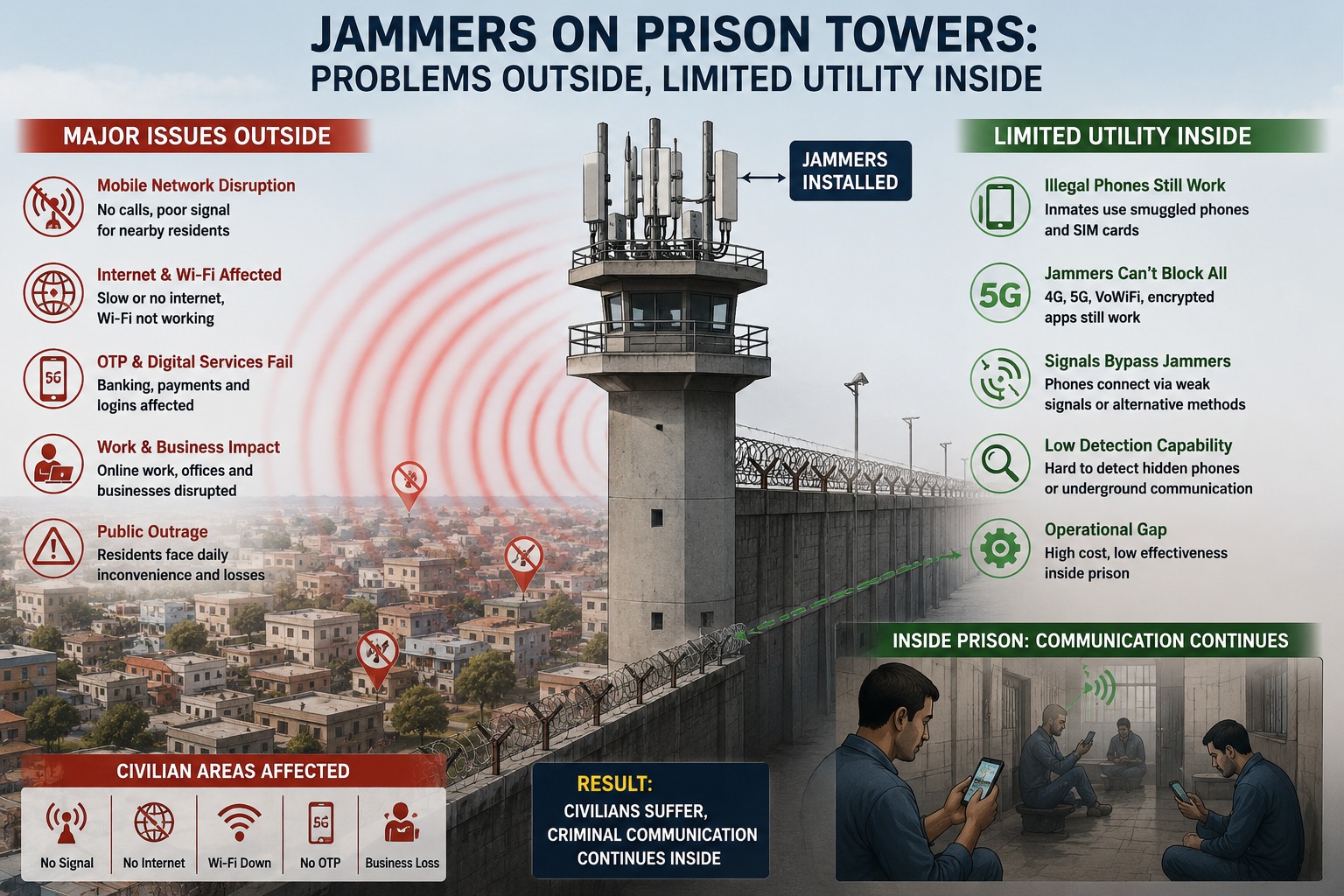
The Jammu & Kashmir Prison Department is moving to acquire and install advanced cellular jamming systems most notably the “V-Kavach” across key prisons in the Union Territory. The decision has ignited a serious backlash from security analysts, telecom engineers, and civil society organizations, who warn that these systems have repeatedly underdelivered inside prisons while wreaking havoc on civilian communications outside their walls.
In a region as sensitive as J&K where prisons sit within a complex threat environment of cross-border signals, drone-borne devices, and rapidly shifting telecom spectra—deploying blunt-force jamming invites operational failure and public fallout.
Limits Exposed: Effectiveness in Serious Doubt
V-Kavach has already been trialed in Punjab’s high-security prisons, including Bathinda and Patiala, with the stated aim of choking off illicit mobile usage behind bars. But evidence on the ground paints a starkly different picture: phones kept working inside facilities that were supposedly blanketed by jammers, and contraband devices continued to surface.
• Reports from Punjab describe inmates still placing calls and circulating videos from inside jails where V-Kavach was said to be active. The Times of India
• Traditional and legacy-style jammers appeared outmatched by modern networks struggling particularly with 4G signals and contemporary protocols. The Times of India
If jammers cannot reliably neutralize illegal devices inside the target area, their core purpose collapses.
Civilian Networks Take the Hit
While failing to fully clamp down inside, the same jammer deployments have reportedly blasted nearby communities with collateral outages crippling mobile coverage, killing Wi Fi, and breaking day to day digital services.
• In Patiala, residents around Central Jail reported call drops, missing OTPs, broken data sessions, and persistent Wi Fi failures after V-Kavach trials, affecting homes, shops, and government offices alike. The Tribune
• Around Bathinda Jail, adjoining villages allegedly slipped into “no-signal” zones, prompting public protests for removal or recalibration of the systems. The Tribune
This is the worst of both worlds: inmates connected, civilians cut off.
Courts Watching, Questions Mounting
The Punjab and Haryana High Court has pressed the state on why illegal phone use persists despite jammer rollouts, forcing regular updates on prison security measures and the real impact of V-Kavach deployments. The controversy surged after high profile custodial interviews and alleged gangster communications surfaced from inside prisons, intensifying doubts over actual control of prison communications. Hindustan Times The Tribune
Why J&K Needs Better Than Blunt Jamming
J&K’s operating environment is significantly tougher than typical state prison contexts:
• Cross border and foreign origin RF signals can bleed into sensitive zones.
• Terror-linked groups adapt quickly, using encrypted and layered comms.
• Drone-assisted payloads and relay devices expand the attack surface.
• Densely packed, overlapping frequency bands complicate clean isolation.
In this landscape, brute-force or static jammers—V-Kavach included—risk being too crude: they’re difficult to contain, easy to route around, and prone to spillover that punishes the public realm.
What Experts Recommend Instead
Modern prison communications control must be precise, adaptive, and verifiable not simply loud. Specialists point to integrated, next generation toolsets that confine and control signals without carpet-bombing the spectrum:
• AI-driven, adaptive jamming with real-time spectrum sensing
• IMSI catchers, lawful interception, and targeted denial against specific devices
• Precision RF containment and beamforming to keep effects inside prison perimeters
• Continuous spectrum monitoring and telemetry to validate coverage and prevent spill
• Counter UAS measures and protocols against drone-borne repeaters and payloads
• Architectural signal isolation inside facilities (shielding, controlled RF zones)
Poorly tuned jammers can create wide electromagnetic splash zones that disrupt households, businesses, hospitals, schools, and even emergency communications—unacceptable in any environment, catastrophic in J&K.
Security Without Sacrificing the Public
Stopping illegal prison communications is essential national security work. But deploying systems that fail inside while breaking civilian life outside is a strategic and public-safety failure. J&K’s threat profile demands more than traditional, static jamming. It requires intelligent, targeted, and measured control solutions that prove they can lock down prison communications while leaving surrounding communities untouched.
Until deployments can demonstrate that level of precision and effectiveness, relying on V-Kavach or similar legacy-style jammers risks producing the exact outcome security planners fear: compromised prisons and alienated citizens.
