


By Bharat Nanda
India’s air-power planning is entering a critical phase. The convergence of China’s expanding military aviation capabilities and Pakistan’s growing dependence on Chinese defence technology is creating a more complex operational environment for the Indian Air Force. The challenge is no longer confined to maintaining an advantage over either adversary individually. It increasingly involves preparing for a regional military environment in which Chinese and Pakistani capabilities could operate through increasingly interconnected surveillance, communications and weapons networks.
For Indian defence planners, the period between 2026 and 2035 deserves particular attention. Pakistan is seeking to acquire fifth-generation combat capabilities, including China’s J-35A, while the People’s Liberation Army Air Force continues to expand its J-20 fleet and develops its next-generation J-36 and J-50 aircraft. India’s indigenous Advanced Medium Combat Aircraft (AMCA), meanwhile, is not expected to provide an operational stealth-fighter capability before the middle of the next decade.
This creates a transitional capability gap that cannot be addressed by waiting for the arrival of a new generation of Indian combat aircraft.
The China–Pakistan military equation
Pakistan’s reported plans to acquire the J-35A represent an important development in the regional military balance. The significance of this prospective acquisition, however, extends beyond the introduction of another fighter aircraft.
The J-35A must be assessed alongside other elements of China’s military technology being introduced into Pakistan’s inventory, particularly the PL-17 long-range air-to-air missile and KJ-500 airborne early-warning and control aircraft.
These platforms serve different operational purposes but could contribute to a more integrated combat architecture.
The J-35A is intended to provide low-observable combat capabilities. The KJ-500 offers airborne surveillance and command-and-control support, while the PL-17 is designed to engage targets at extended ranges. Together, they could strengthen Pakistan’s ability to challenge India’s air operations, particularly by threatening high-value supporting assets.
This is a significant shift in the character of the threat.
Modern air warfare is not determined exclusively by the performance of frontline fighters. Airborne early-warning aircraft, aerial refuelling platforms, surveillance systems and communications networks provide the information and operational support that enable combat aircraft to function effectively.
An adversary capable of threatening these assets can disrupt an entire air campaign without necessarily establishing conventional air superiority.
The PL-17 is particularly relevant in this context. The comparative assessment places its estimated engagement range at approximately 400 kilometres. Although its actual operational performance and engagement envelope remain difficult to establish through open-source information, its intended role highlights the growing importance of very-long-range air-to-air weapons.
For India, this reinforces the need to accelerate the development and integration of the Astra Mk2 and Astra Mk3 programmes, alongside other extended-range missile options.
The Meteor remains a significant capability for the Rafale, but India’s longer-term weapons requirements must account for the evolving reach of Chinese and potentially Pakistani missile systems.
China’s expanding stealth-fighter advantage
Pakistan’s prospective fifth-generation acquisition is only one part of the wider challenge.
China already fields a substantial J-20 stealth-fighter fleet. The October 2026 assessment estimates approximately 300 aircraft, with production continuing at a significant rate. The introduction of additional aircraft, potentially including the J-35A, would further strengthen the PLA Air Force’s ability to generate combat power across multiple theatres.
The development of the J-36 and J-50 adds another dimension.
These sixth-generation demonstrators are designed around extended combat radius, larger internal weapons capacity, broadband low observability and crewed–uncrewed coordination. Their potential entry into service around 2030–32 remains an assessment rather than a confirmed operational timeline.
Nevertheless, their development provides an indication of the direction in which Chinese air-power planning is moving.
The estimated combat radius of the J-36, if achieved, could substantially expand the reach of Chinese air operations from bases in Tibet and Xinjiang. It would also increase the potential threat to India’s military infrastructure and strategic installations across the subcontinent and the northern Indian Ocean.
For Indian planners, this changes the traditional calculation of geographical depth.
Air bases that were previously considered relatively secure because of their distance from likely operational areas may face greater exposure to long-range aircraft and missile systems. The survivability of forward and rear-area infrastructure will consequently depend on dispersal, hardened shelters, air defence and the resilience of command-and-control networks.
The maritime dimension must also be considered. China’s expanding naval aviation capabilities and the potential development of carrier-compatible advanced aircraft could increase pressure on Indian interests in the Indian Ocean.
India’s air-power response must therefore be planned across both continental and maritime theatres.
The force-structure problem
Perhaps the most immediate concern for India is the numerical dimension of the emerging challenge.
The comparative study places the Indian Air Force at approximately 30 fighter squadrons against an authorised strength of 42. It also highlights the possibility of a substantial combined Chinese and Pakistani fifth-generation fighter inventory by 2030.
The precise numbers and induction schedules remain subject to uncertainty. However, the underlying force-structure problem is clear: India must maintain credible deterrence against two adversaries while its indigenous stealth-fighter programme is still under development.
This is not a problem that can be solved through a single procurement decision.
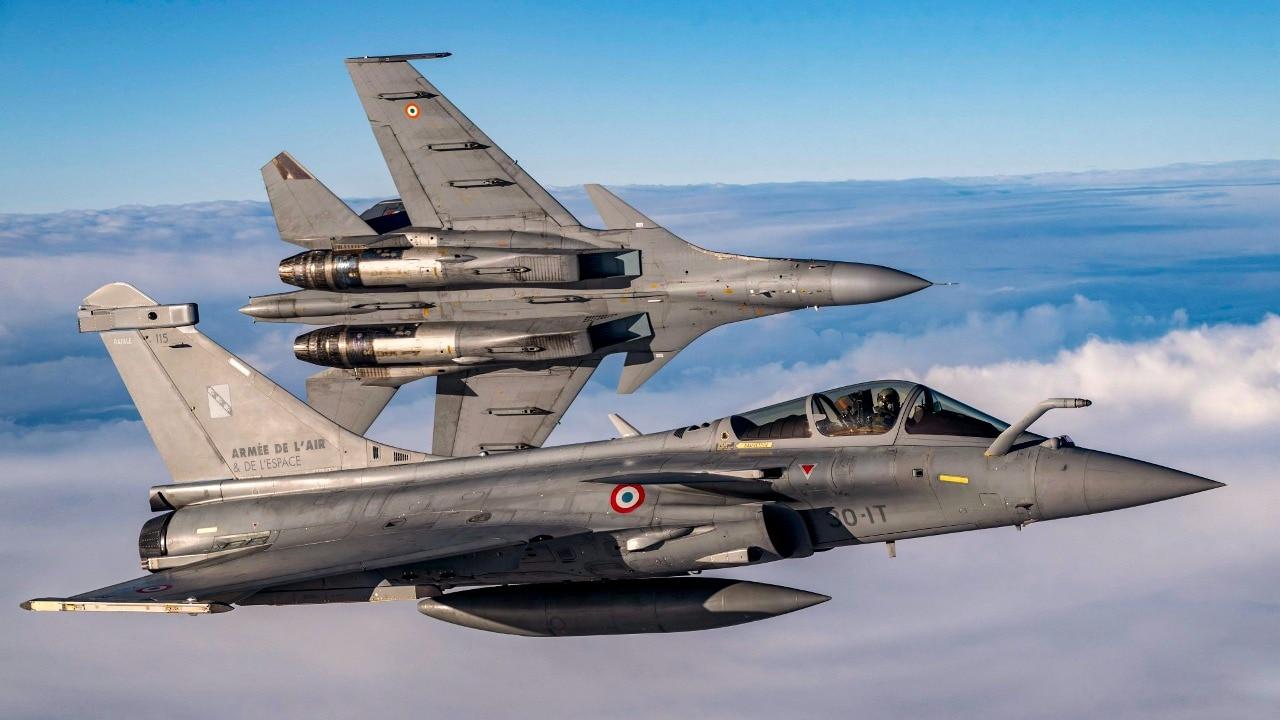
The Rafale, Su-30MKI and Tejas fleets must form the foundation of India’s immediate response. Their operational effectiveness will increasingly depend on weapons integration, electronic warfare, sensor upgrades and access to a reliable common operational picture.
The Rafale should be viewed as an important bridge through the 2026–35 capability gap. Its advanced electronic warfare suite, Meteor missile and multirole capabilities provide the IAF with considerable operational flexibility. However, it is not a stealth aircraft and cannot independently eliminate the disadvantages associated with facing low-observable adversary platforms.
The Su-30MKI remains equally important because of its numbers, payload capacity and potential for modernisation. The proposed Super-30 upgrade, including improved sensors, infrared search-and-track capability and longer-range weapons, could significantly extend its operational relevance.
The Tejas Mk1A and Mk2 programmes are also essential to rebuilding the numerical strength of the combat fleet.
India must avoid a situation in which the pursuit of advanced platforms comes at the expense of the numbers required to sustain air operations.
The surveillance and targeting challenge
The next major priority is strengthening India’s ability to detect and track low-observable aircraft.
Stealth does not make an aircraft invisible. It reduces the range and effectiveness of detection by particular radar systems, especially conventional fire-control radars operating in specific frequency bands.
A layered detection architecture incorporating VHF and L-band radars, passive sensors, infrared surveillance and airborne early-warning platforms can improve the ability to identify and track stealth targets.
India’s Ashwini and Arudhra radar programmes, alongside the proposed Project Kusha architecture, are relevant to this effort. Their effectiveness will depend on integration into a wider network rather than their deployment as isolated systems.
Airborne early-warning and control aircraft deserve equal priority.
The KJ-500 provides China with an important airborne surveillance and command capability. India’s comparatively limited AEW&C inventory creates a potential vulnerability, particularly in a two-front contingency.
The expansion of the Netra Mk2 programme and the integration of airborne, ground-based and space-based sensors should therefore be treated as essential force multipliers.
The objective must be to develop a common operational picture that connects the Air Force’s surveillance assets with wider military command-and-control networks.
Preparing for a two-front air campaign
India must also reconsider how it approaches the China–Pakistan military relationship.
It would be incorrect to assume that the two countries will automatically operate as a single military force in every contingency. Their strategic interests, operational priorities and political calculations will not always be identical.
However, their growing defence cooperation, shared equipment and potential exchange of intelligence create the possibility of a more coordinated threat environment.
Indian planning must account for that possibility.
This requires greater emphasis on electronic warfare, suppression and destruction of enemy air defences, cyber resilience and the ability to disrupt adversary surveillance and communications networks.
The objective should not simply be to match the number of aircraft deployed by the adversary. It should be to identify and weaken the enabling architecture that allows those aircraft to operate effectively.
China’s reliance on integrated surveillance, satellite intelligence and airborne command systems also creates identifiable dependencies. These systems are not invulnerable, and their effectiveness in a contested environment should not be assumed.
India must develop the capability to operate against the entire adversary network rather than concentrating exclusively on fighter-to-fighter engagements.
The strategic priority
The Indian Air Force is approaching a period in which the quality, numbers and integration of its combat assets will be tested simultaneously.
The immediate challenge is the possibility of a Chinese-supported fifth-generation capability entering Pakistan’s inventory while China continues to expand its own advanced fighter fleet. The longer-term challenge is the arrival of Chinese sixth-generation aircraft and the wider transformation of regional air warfare.
India cannot afford to treat these developments as separate problems.
The priorities are clear: strengthen the existing fighter fleet, accelerate long-range missile development, expand AEW&C and counter-stealth surveillance, improve base survivability and develop a network capable of connecting air, land, maritime and space-based assets.
The AMCA will remain central to India’s long-term ambitions, but it cannot substitute for the operational capabilities required today.
The decisive test for Indian defence planning will be whether the country can close the immediate capability gaps while building a force designed for the demands of future air warfare.
The next decade will not simply determine the composition of the Indian Air Force. It will shape India’s ability to maintain credible air deterrence across its continental and maritime security environment.
