


By Ravish Handoo
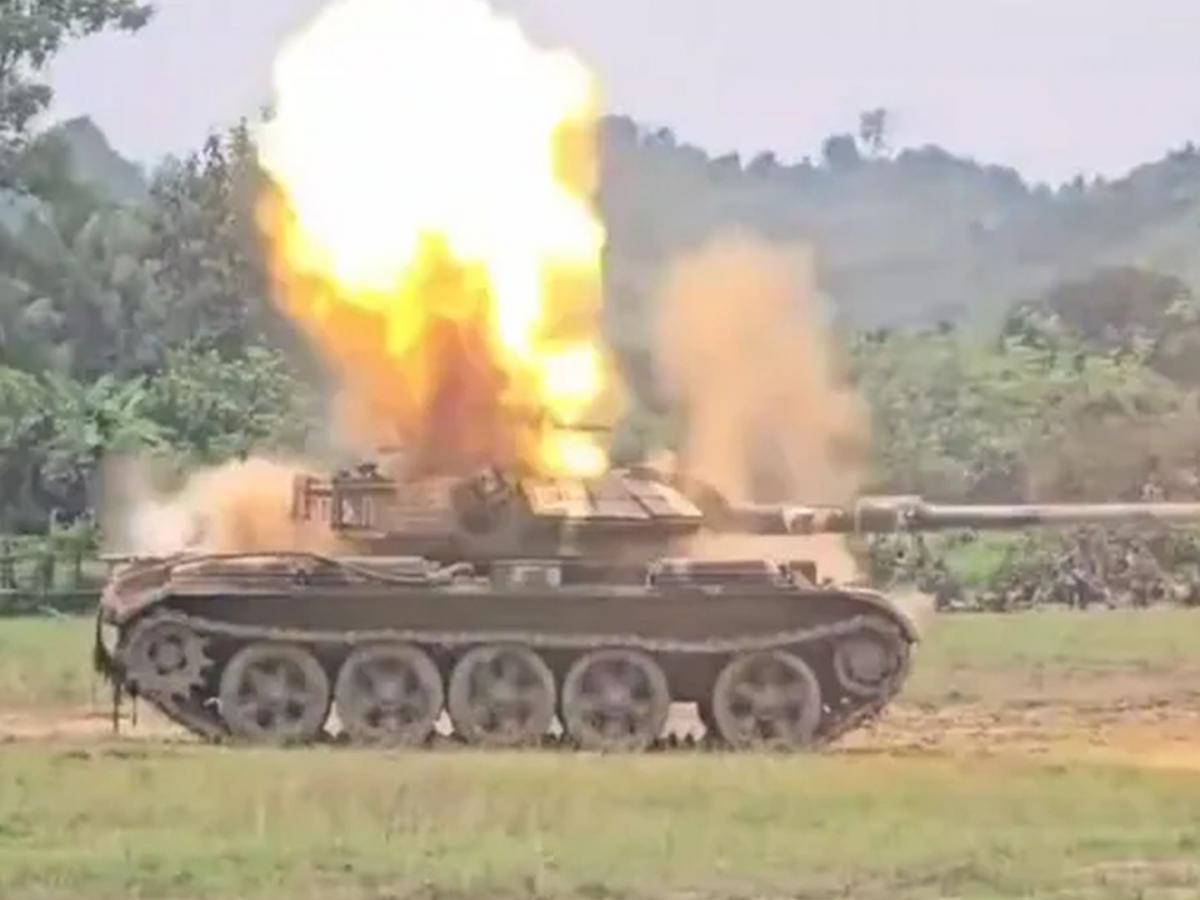
A routine field-firing exercise at the Hathazari range in Chattogram turned deadly on September 9, 2026. A T-59 tank suffered a gun malfunction during live firing, killing two Bangladesh Army soldiers and leaving an officer critically injured.
The Bangladesh Army has not publicly identified the exact tank involved in the accident. Yet the incident has inevitably drawn attention to a broader issue. China has been Bangladesh’s dominant supplier of tanks and other major military platforms for decades, and the Hathazari tragedy has once again brought questions about the reliability, durability and long-term support of Chinese military hardware into public discussion.
Had this been an isolated accident, it could perhaps have been viewed simply as one of the risks associated with military training. Unfortunately, concerns surrounding Chinese-origin defence equipment have surfaced repeatedly over the years and across different countries.
China has built a formidable defence-export industry. Its proposition is easy to understand. Chinese weapons often appear technologically sophisticated, are aggressively marketed and usually come at prices lower than comparable Western platforms. For developing countries working with limited defence budgets, that combination can be extremely attractive.
But buying a weapon is only the first step.
The real test comes years later: Can it remain operational in difficult climates? Are spare parts readily available? Can ammunition be supplied consistently? Does the manufacturer provide reliable technical support? Most importantly, can soldiers trust the system when their lives depend on it?
It is on these questions that the experience of some countries using Chinese equipment has generated unease.
Consider the Chinese VT-4 main battle tank. It is marketed as a modern platform armed with a 125mm gun and equipped with advanced electronics and sophisticated fire-control systems. Yet in December 2025, a VT-4 operated by the Royal Thai Army suffered a serious gun-barrel failure during live firing near the Cambodian border, injuring members of its crew.
Questions have also been raised from time to time about the operational performance of Chinese armoured vehicles in countries such as Nigeria and Kenya, where users have encountered complaints concerning maintenance, protection or other operational limitations.
None of these incidents, taken individually, is enough to declare an entire family of weapons defective. Military hardware fails everywhere. But when similar complaints begin emerging from different operators, they naturally attract closer scrutiny.
The concerns are not limited to tanks.
Algeria has faced problems involving Chinese CH-4 drones, while Chinese unmanned systems supplied to customers in the Middle East have also attracted criticism over reliability and performance in harsh desert conditions.
This is where the difference between a defence exhibition and an operational deployment becomes important. Heat, dust, prolonged sorties, intensive use and the constant requirement to keep equipment serviceable can reveal weaknesses that may never become visible during carefully managed trials or demonstrations.
A system that performs impressively during a controlled evaluation must still prove that it can survive years of real-world operations.
Bangladesh is especially relevant to this discussion because its military relationship with China is neither recent nor marginal. Beijing has remained Dhaka’s largest defence supplier for years, and Chinese-origin platforms are spread across the Bangladesh Army, Air Force and Navy.
The Bangladesh Army’s armoured inventory includes Type 59 derivatives, Type 69s, MBT-2000s and newer VT-5 light tanks. That dependence has also brought reported difficulties. Bangladesh’s MBT-2000 fleet has faced reports concerning firing problems and spare parts. Questions have been raised over Chinese ammunition, while reports surrounding newer armoured platforms have pointed towards mechanical and material-related concerns.
A T-59G Durjoy was also involved in a serious incident during trial firing in Chattogram in May 2024.
The September 2026 accident at Hathazari has therefore revived questions that were already present.
The picture becomes even more sensitive when aircraft are considered.
On July 21, 2025, a Chinese-made FT-7BGI fighter trainer of the Bangladesh Air Force crashed into a school campus in Dhaka. At least 35 people were killed, many of them children. It became one of Bangladesh’s worst aviation tragedies in years.
Aircraft accidents can result from many causes: mechanical failure, maintenance problems, pilot error or a combination of factors. It would therefore be wrong to assume that every accident involving Chinese equipment occurred simply because the platform was Chinese.
That distinction is important.
But it is equally reasonable for military planners to examine patterns when concerns surface repeatedly across several platforms and countries. Manufacturing standards, maintenance requirements, availability of spares and long-term reliability are legitimate subjects of examination for any major defence supplier.
Bangladesh has also raised concerns about Chinese-supplied naval equipment and defective components.
Yet reducing dependence on a supplier is far more difficult than it sounds.
Once an armed force has operated equipment from one country for decades, an entire ecosystem develops around it. Personnel are trained on those platforms. Ammunition stocks are designed around them. Workshops, maintenance facilities and technical expertise are built to support them. Supply chains and logistics gradually become tied to the original manufacturer.
Changing suppliers therefore does not simply mean purchasing another tank, aircraft or warship. It can mean rebuilding an entire military support structure.
That helps explain why countries often continue purchasing equipment from an existing supplier even after experiencing problems with individual systems.
The India-Pakistan confrontation in May 2025 and Operation Sindoor added another dimension to the debate over Chinese military technology.
For China, the confrontation was not merely another regional military crisis. It also became an unintended operational test of systems supplied to one of its closest defence partners.
Pakistan has spent years incorporating Chinese fighters, radars, air-defence systems, drones and other military equipment into its armed forces. If there was ever a situation in which these systems could demonstrate their effectiveness against a technologically capable adversary, May 2025 provided such an opportunity.
India nevertheless succeeded in carrying out precision strikes against important Pakistani military targets. Indian weapons were able to penetrate defended areas and strike airbases and other military infrastructure.
That inevitably raised questions about the effectiveness of Pakistan’s Chinese-origin air-defence network.
Those questions must also be kept in perspective. No air-defence system in the world provides an impenetrable shield. Even highly advanced networks can be saturated, deceived, suppressed or penetrated. Drawing sweeping conclusions about an entire defence industry from one short military confrontation would therefore be simplistic.
But weapons are ultimately purchased for precisely these moments.
When hostile missiles, drones or aircraft are approaching, catalogue specifications cease to matter. What matters is whether the radar detects the threat, whether the command system identifies and tracks it correctly, whether interceptors respond in time and whether the incoming weapon is stopped before reaching its target.
Operation Sindoor therefore gave analysts another opportunity to examine how Chinese-origin military equipment performs when confronted by a capable adversary rather than during demonstrations, exercises or defence exhibitions.
The same confrontation also highlighted a different trend: India’s growing ability to design, manufacture and deploy sophisticated military systems of its own.
The BrahMos supersonic cruise missile stands out prominently.
Jointly developed by India and Russia and increasingly manufactured within India’s expanding defence-industrial ecosystem, BrahMos has evolved from a prestigious missile-development programme into an operational weapon and an export product.
Its reported employment against Pakistani military targets during Operation Sindoor gave the missile something that no marketing brochure can provide: combat credibility.
That matters enormously in the global arms market.
Countries do not purchase weapons simply because a brochure lists impressive range, speed, accuracy or firepower. Defence planners want to know whether the system has actually performed under operational conditions. They want confidence that ammunition will be available when required, spare parts will continue arriving years after purchase and technical support will remain available long after the signing ceremony is over.
Combat experience can therefore shape the international reputation of a weapon far more powerfully than any demonstration at a defence exhibition.
India’s ATAGS artillery programme reflects the same transformation taking place within the country’s defence sector.
Developed in India with substantial participation from the private sector, including the Kalyani Group, the Advanced Towed Artillery Gun System has attracted attention outside India as well.
Armenia’s expanding defence relationship with India is particularly significant. Yerevan has purchased Indian military equipment and has continued exploring additional acquisitions. In the defence industry, a customer returning for more equipment can sometimes provide a stronger endorsement than the most elaborate advertising campaign.
The comparison, however, should not be reduced to the argument that every Chinese weapon is unreliable or every Indian system is automatically superior.
China possesses one of the largest and most sophisticated defence-industrial bases in the world. The People’s Liberation Army operates advanced systems that cannot simply be equated with every export model sold overseas.
Nor is equipment failure unique to China.
American, Russian, European and Indian military systems have all suffered accidents, technical failures and operational setbacks. Complex military machines operate under extreme stresses, and failures are an unavoidable part of military aviation, armoured warfare, artillery and naval operations.
The real question is different.
When similar concerns begin appearing across tanks, drones, aircraft, ammunition and naval equipment supplied to different countries, do they represent isolated failures or signs of a wider problem? And when problems are identified, how quickly and effectively does the manufacturer respond?
These are questions that defence ministries cannot afford to ignore.
Competitive pricing can help win a contract. Attractive financing can make a deal politically and economically easier. A long list of specifications can impress a procurement committee.
But none of those advantages can indefinitely compensate for weak maintenance support, unreliable components, shortages of spare parts or equipment that struggles after years of demanding operational use.
That may ultimately be one of China’s most important challenges as an international arms exporter.
Beijing has already demonstrated that it can manufacture military equipment in enormous quantities and sell it aggressively across Asia, Africa and the Middle East. What it must demonstrate just as consistently is that those systems remain dependable long after the contracts are signed—and, above all, when they are finally required in combat.
For the soldier sitting inside a tank, the pilot strapped into a cockpit or the sailor aboard a warship, this is not an abstract debate about geopolitics, defence exports or industrial competition.
A weapon is something they are expected to trust with their lives.
The two Bangladesh Army soldiers killed at Hathazari were participating in what should have been a routine military exercise. Their deaths are a reminder that the true worth of military hardware is not decided beneath exhibition lights, inside glossy catalogues or through carefully prepared presentations.
It is decided on the firing range.
And ultimately, it is decided on the battlefield.
That is where the brochure ends and the real test begins.
Ravish Handoo is a geopolitical analyst, television commentator, and regular participant in television debates on national and international affairs.
