

• Home
  • Personalized
    • My Feed
    • My Saves
    • My Interests
    • History
  • Pages
    • Search Page
    • 404 Page
  • Blog
Epilogue
Subscribe
Epilogue
  • Home
  • J&K
    J&KShow More
    Silence in J&K Reflects Fear, Not Normality, Says Mehbooba Mufti
    1 Min Read
    Overnight Blaze Sweeps Through Market Near Jammu Railway Station
    1 Min Read
    Crime Branch Chargesheets Budgam Man in Alleged ₹2 Crore Investment Fraud
    1 Min Read
    Kashmiri Umrah Pilgrims Stranded in Saudi Arabia Appeal for Help After Flight Cancellations
    1 Min Read
    Omar Meets LG Sinha, Says Cabinet Expansion and Reshuffle Planned Next Week
    1 Min Read
  • Nation
    NationShow More
    14 States Back Retirement Age of 62 for Judicial Officers, SC Notes
    1 Min Read
    Parliaments Have Key Role in Building Trust Between Nations: Birla
    2 Min Read
    India Plans Four Working Launch Pads by 2029, Says ISRO Chief
    1 Min Read
    No Justification for Terrorism as State Policy, Says Jaishankar
    1 Min Read
    Modi Warns Economies Are Targets of Modern Warfare, Urges Banks to Bolster Cyber Defences
    1 Min Read
  • World
    WorldShow More
    Saudi Authorities Lift Alerts After Aerial Threat Warnings in Four Cities
    1 Min Read
    India Expresses Solidarity With Jordan After Deadly Church Attack
    1 Min Read
    IndiGo Cancels Riyadh Flights Through October 31 Amid Saudi Security Concerns
    1 Min Read
    Earthquake Measuring 5.3 Strikes Northwest China, No Immediate Casualties Reported
    1 Min Read
    India Showcases Homegrown Water Technologies at WETEX 2026 in Dubai
    1 Min Read
  • Sports
    SportsShow More
    Deepthi Jeevanji Retains Asian Para Games 400m T20 Title With Record Run
    1 Min Read
    West Indies Beat India by 24 Runs to Take T20 Series Into Decider
    1 Min Read
    PM Modi to Interact With Asian Games Athletes in Delhi Today
    1 Min Read
    India Rises to Fourth After Winning Nine Medals at Asian Games
    2 Min Read
    PM Modi Applauds Indian Athletes for Stellar Asian Games Performances
    2 Min Read
  • Politics
    PoliticsShow More
    Is India Living Up to the Ideals of Democracy?  A Constitutional Reappraisal
    15 Min Read
    Over 1 Lakh Voter Enumeration Forms Digitised in Delhi
    1 Min Read
    MLC election nominations conclude across Maharashtra
    1 Min Read
    J&K Prisons Push V-Kavach Jammers Despite Doubts Over Performance and Collateral Damage (Mounting Scrutiny as Technology Questioned in Punjab Now Heads to J&K
    5 Min Read
    Punjab Municipal Polls See 64% Turnout
    1 Min Read
  • Business
    BusinessShow More
    Global Education, Global Careers: Exploring Opportunities Beyond Borders
    8 Min Read
    India’s Rising Energy Needs To Drive 2.5-Fold Demand Growth By 2047
    2 Min Read
    Youth Skill Development Key To Viksit Bharat Vision: Govt
    2 Min Read
    US-Iran Talks Trigger Decline in Crude Oil Prices Worldwide
    3 Min Read
    SEBI Focuses on Governance, Investor Trust
    1 Min Read
  • Lifestyle
    LifestyleShow More
    Aruna Irani’s Husband And Filmmaker Kuku Kohli Passes Away At 77
    1 Min Read
    Awarapan 2 Emerges As Major Hindi Box Office Success
    1 Min Read
    Fashion Influencer Urges Bollywood Actors to Respect Runway Protocol
    1 Min Read
    Shah Rukh Khan honoured with “Global Style Icon” award in Dubai
    1 Min Read
    Anil Kapoor’s New Avatar to Surprise Fans in SRK’s ‘King’
    1 Min Read
  • Opinion
    OpinionShow More
    Blood and Betrayal in PoJK: How Pakistan’s Military Tyranny and the ISI Terror Nexus Stand Exposed at the United Nations
    11 Min Read
    India’s Himalayan Shield Is Being Built on Roads, Runways and Information
    7 Min Read
    Trump–Xi Summit: Limited Outcomes, Significant Implications for India
    6 Min Read
    Dial-A-Soldier: Pakistan Discovers the Gig Economy of War
    5 Min Read
    Nathu La 1967: The Battle That Restored India’s Confidence Against China
    6 Min Read
  • Legal
    LegalShow More
    Five SC judges sworn in today, strength rises to 37
    1 Min Read
    J&K Cabinet Considers Opening Doors to Private Varsities
    2 Min Read
    Jammu DC Transfers 48 Junior Assistants for Efficiency
    1 Min Read
    Administration of Ladakh Finalizes Plans for Buddha Relics Exposition
    1 Min Read
    HC Directs Return of Land Taken Without Legal Acquisition
    1 Min Read
Subscribe
  • Contact
  • About
  • Archieve
  • Submit News
Tuesday, Oct 27, 2026
EpilogueEpilogue
Font ResizerAa
  • Home
  • J&K
  • Nation
  • World
  • Sports
  • Politics
  • Business
  • Lifestyle
  • Opinion
  • Legal
Search
  • Home
  • J&K
  • Nation
  • World
  • Sports
  • Politics
  • Business
  • Lifestyle
  • Opinion
  • Legal
Follow US
Epilogue > Blog > Opinion > India’s Himalayan Shield Is Being Built on Roads, Runways and Information
Opinion

India’s Himalayan Shield Is Being Built on Roads, Runways and Information

Editor
Last updated: October 5, 2026 9:32 pm
Editor
Share
SHARE

By Ravish Handoo

In the Himalayas, distance is a strategic fact. A post may be only a few kilometres from a sensitive point, yet separated from timely support by snow, broken roads, thin air and unforgiving terrain. The confrontations at Doklam in 2017 and Galwan in 2020 made one lesson difficult to ignore: holding the frontier depends not only on the soldier at the post, but on how quickly India can move, supply, observe and reinforce.

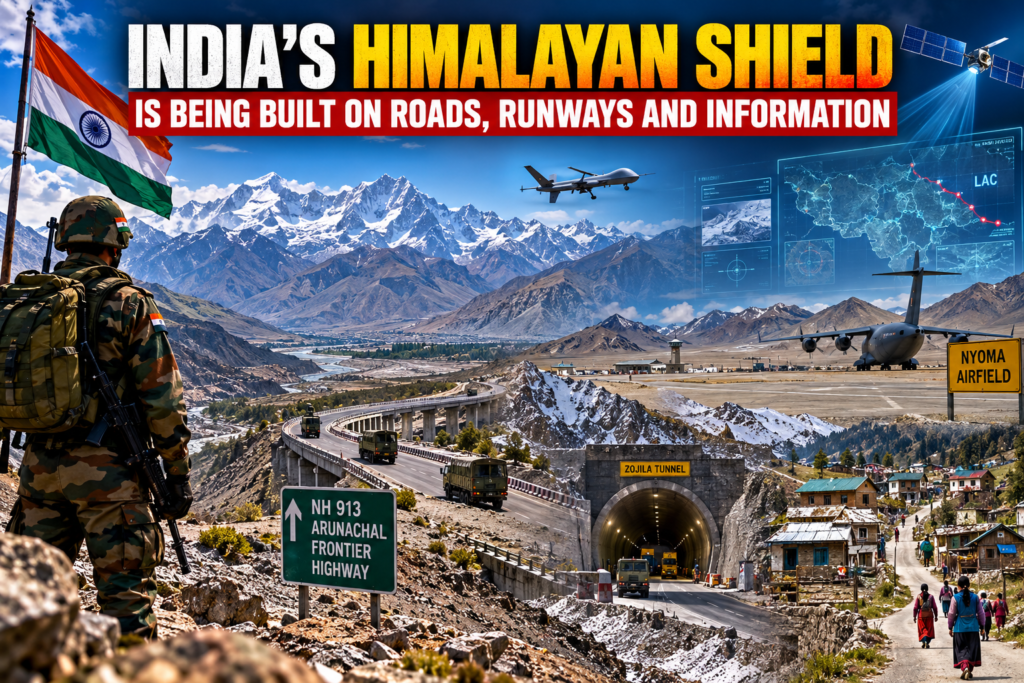
India’s answer is taking shape across several fronts. Roads and tunnels are pushing deeper into difficult terrain. Airfields and advanced landing grounds are shortening the distance between bases and frontier positions. Drones, satellites and sensors are helping commanders see more of a landscape that can conceal movement and disrupt communication. Border villages are being brought into development programmes that can improve daily life while strengthening India’s presence.

The approach is sensible. Its success, however, will depend on execution: whether projects are completed on time, remain usable in extreme weather and connect into a dependable network rather than stand as isolated achievements.

The Arunachal Frontier Highway, designated NH 913, is central to this effort. Planned to run for nearly 1,824 kilometres across Arunachal Pradesh, the corridor is intended to connect remote areas from the western part of the state towards Vijaynagar in the southeast. In 2024, the government sanctioned more than ₹6,700 crore for eight stretches covering over 300 kilometres. Work has been taken up on sections including Tato–Monigong, Hunli–Hayuliang and Pango–Jorging.

For communities, the highway could mean more reliable access to schools, healthcare, markets and emergency services. For the military, it offers the prospect of faster movement across areas where geography has long shaped the pace of operations. Those purposes reinforce one another. A road that serves local residents can also strengthen logistics; a corridor built for strategic access can connect villages that have remained isolated.

But a highway on a map is not yet a strategic advantage. The real test is whether it can be built and maintained across landslide-prone slopes, river valleys and severe weather. A frontier road network needs bridges, alternate routes, reliable communications and maintenance plans that account for the conditions in which it must operate. Resilience comes from the system around the road as much as from the road itself.

That is why tunnels and all-weather links matter. The Atal Tunnel has improved access through the Pir Panjal range, while the Zojila tunnel project is intended to make the Srinagar–Leh route less vulnerable to seasonal closure. In Ladakh, dependable access has direct consequences for both civilian life and military logistics. Yet each project must be judged by the practical change it delivers: how many days access is maintained, how quickly supplies move and how effectively disruptions can be managed.

Air access is the other part of the equation. In a region where ground movement can be slow or blocked, high-altitude airfields and advanced landing grounds provide options for moving personnel and essential supplies. The development of Nyoma airfield in Ladakh, alongside the use of Daulat Beg Oldi, strengthens India’s ability to operate in remote sectors. In Arunachal Pradesh, upgraded landing grounds can support logistics and emergency response.

Air infrastructure does not replace roads. Aircraft depend on weather, availability and specialised support; roads provide the sustained movement needed to supply and maintain forces. The advantage comes from combining the two, so that a disruption in one route does not leave a frontier position cut off.

Technology adds another layer. Satellites, unmanned aerial vehicles, radars, electro-optical equipment and ground sensors can help build a clearer picture of activity across a vast and difficult landscape. Secure communications allow that information to reach the people who need to act on it. In mountains, where terrain can block line of sight and weather can change rapidly, early warning and reliable communication can matter as much as physical access.

Yet equipment alone does not produce information superiority. Sensors must be integrated, data assessed and communications protected. Technology must give commanders usable, timely information—not simply more feeds to monitor. It can help reduce uncertainty, but it cannot remove the need for trained personnel, sound judgment and strong logistics.

The civilian dimension is equally important. The Vibrant Villages Programme aims to improve infrastructure and livelihoods in selected border communities. Better electricity, roads, healthcare, digital access and economic opportunities can make life more viable in places where remoteness has often pushed people towards leaving. A thriving village also sustains India’s administrative and social presence along the frontier.

That presence must be built around residents’ needs. Development cannot be treated as a security instrument alone. Villages are homes and communities, not markers on a map. If programmes deliver lasting services and livelihoods, the benefits will extend beyond their strategic value. If they do not, official announcements will not reverse the pressures that drive migration.

India’s Himalayan frontier is therefore being shaped by more than construction. It is an effort to connect mobility, air access, surveillance, communications and community development into a working network. NH 913 could become a major part of that network, but its significance will depend on the links it creates and the reliability it delivers.

The strongest frontier is not necessarily the one with the most projects. It is the one where roads remain open, airfields are usable, information reaches decision-makers, supplies arrive when needed and border communities can build a future. India has begun assembling those elements. The measure of its strategy will be whether they work together—on the ground, in every season.

Editor
Editor
Share This Article
Facebook Twitter Copy Link Print
Leave a comment

Leave a Reply Cancel reply

Your email address will not be published. Required fields are marked *

House of Texture: Luxury Bed Linen Online
  • Buy Luxury Bed Sheets India
  • Buy Luxury Bed Cover India
  • Buy Luxuury Cushions and Lumbar India
  • Buy Luxury Bedding Set India
  • Buy Kashmiri Embroidered Cushion Cover
  • Buy Electric Blankets India

You Might Also Like

Opinion

Blood and Betrayal in PoJK: How Pakistan’s Military Tyranny and the ISI Terror Nexus Stand Exposed at the United Nations

11 Min Read
Opinion

Trump–Xi Summit: Limited Outcomes, Significant Implications for India

6 Min Read
Opinion

Dial-A-Soldier: Pakistan Discovers the Gig Economy of War

5 Min Read
Opinion

Nathu La 1967: The Battle That Restored India’s Confidence Against China

6 Min Read

Social Networks

Facebook-f Twitter Youtube

As Seen On

Epilogue
Epilogue
Epilogue
Epilogue

©2024 Epilogue. All Rights Reserved. | Powered by Ideogram Technology Solutions [P] Ltd.

Epilogue
Epilogue
Welcome Back!

Sign in to your account

Lost your password?