

• Home
  • Personalized
    • My Feed
    • My Saves
    • My Interests
    • History
  • Pages
    • Search Page
    • 404 Page
  • Blog
Epilogue
Subscribe
Epilogue
  • Home
  • J&K
    J&KShow More
    LG Sinha Extends Warm Greetings to People on Ganesh Chaturthi
    1 Min Read
    Public Advisory Issued Ahead of Kailash Yatra-2026
    1 Min Read
    Dr Jitendra Singh Announces Participation of Three Nobel Laureates at Delhi Conclave
    2 Min Read
    Satwari Eviction Drive: NHAI Demolishes 17 Shops, Traders Seek Relief
    2 Min Read
    Peace, Public Safety Top Priority, Says IGP Kashmir
    2 Min Read
  • Nation
    NationShow More
    BRICS Summit Will Offer Opportunity for Positive Discussions, Says PM Modi
    2 Min Read
    Jaishankar Stresses Greater BRICS Cooperation to Address Economic Hurdles
    2 Min Read
    Representative graphic: India Showcases ₹5.35-Lakh-Crore Industrial Smart City Investment Potential
    India Showcases ₹5.35-Lakh-Crore Industrial Smart City Investment Potential
    4 Min Read
    Representative graphic: FIU Issues Notices to 15 Non-Compliant Virtual Asset Platforms
    FIU Issues Notices to 15 Non-Compliant Virtual Asset Platforms
    4 Min Read
    Representative graphic: Cabinet Approves ₹10,021-Crore Railway Expansion Across Four Southern States
    Cabinet Approves ₹10,021-Crore Railway Expansion Across Four Southern States
    4 Min Read
  • World
    WorldShow More
    25 Years On, US Remembers Victims of 9/11 Terrorist Attacks
    2 Min Read
    Nepal-Tibet Flood Disaster Leaves 165 Dead, Over 1,000 Missing Across Border
    2 Min Read
    US Moves To Impose $103,265 Extra Fee On Certain H-1B Petitions
    2 Min Read
    Canada Unveils Retaliatory Tariffs On Over 700 US Products
    2 Min Read
    Zelenskyy Thanks India For Independence Day Greetings
    1 Min Read
  • Sports
    SportsShow More
    India Enforce Follow-On After Sri Lanka Fall 213 Runs Short
    1 Min Read
    R Praggnanandhaa Sets Up Grand Chess Tour Final Against Fabiano Caruana
    1 Min Read
    Khelo India Samvad To Bring Youth Closer To India’s Sporting Vision
    2 Min Read
    Grand Chess Tour rapid ends with Indian star on top
    1 Min Read
    Suryakumar Yadav leads India in Manchester
    2 Min Read
  • Politics
    PoliticsShow More
    Is India Living Up to the Ideals of Democracy?  A Constitutional Reappraisal
    15 Min Read
    Over 1 Lakh Voter Enumeration Forms Digitised in Delhi
    1 Min Read
    MLC election nominations conclude across Maharashtra
    1 Min Read
    J&K Prisons Push V-Kavach Jammers Despite Doubts Over Performance and Collateral Damage (Mounting Scrutiny as Technology Questioned in Punjab Now Heads to J&K
    5 Min Read
    Punjab Municipal Polls See 64% Turnout
    1 Min Read
  • Business
    BusinessShow More
    Global Education, Global Careers: Exploring Opportunities Beyond Borders
    8 Min Read
    India’s Rising Energy Needs To Drive 2.5-Fold Demand Growth By 2047
    2 Min Read
    Youth Skill Development Key To Viksit Bharat Vision: Govt
    2 Min Read
    US-Iran Talks Trigger Decline in Crude Oil Prices Worldwide
    3 Min Read
    SEBI Focuses on Governance, Investor Trust
    1 Min Read
  • Lifestyle
    LifestyleShow More
    Aruna Irani’s Husband And Filmmaker Kuku Kohli Passes Away At 77
    1 Min Read
    Awarapan 2 Emerges As Major Hindi Box Office Success
    1 Min Read
    Fashion Influencer Urges Bollywood Actors to Respect Runway Protocol
    1 Min Read
    Shah Rukh Khan honoured with “Global Style Icon” award in Dubai
    1 Min Read
    Anil Kapoor’s New Avatar to Surprise Fans in SRK’s ‘King’
    1 Min Read
  • Opinion
    OpinionShow More
    Makkah Pact: Pakistan Failed, and the Pact Failed Its First Test
    6 Min Read
    When the Battlefield Tests the Brochure: Questions Over Chinese Military Hardware
    14 Min Read
    HOW SECURE IS OUR DEMOCRACY?
    16 Min Read
    The Quiet Change in Jammu and Kashmir Seven Years After Article 370, the Most Meaningful Transformation Is the Return of Ordinary Life
    10 Min Read
    Seven Years After Article 370: A Citizen’s View of a Changing Jammu and Kashmir
    10 Min Read
  • Legal
    LegalShow More
    Five SC judges sworn in today, strength rises to 37
    1 Min Read
    J&K Cabinet Considers Opening Doors to Private Varsities
    2 Min Read
    Jammu DC Transfers 48 Junior Assistants for Efficiency
    1 Min Read
    Administration of Ladakh Finalizes Plans for Buddha Relics Exposition
    1 Min Read
    HC Directs Return of Land Taken Without Legal Acquisition
    1 Min Read
Subscribe
  • Contact
  • About
  • Archieve
  • Submit News
Tuesday, Sep 15, 2026
EpilogueEpilogue
Font ResizerAa
  • Home
  • J&K
  • Nation
  • World
  • Sports
  • Politics
  • Business
  • Lifestyle
  • Opinion
  • Legal
Search
  • Home
  • J&K
  • Nation
  • World
  • Sports
  • Politics
  • Business
  • Lifestyle
  • Opinion
  • Legal
Follow US
Epilogue > Blog > Opinion > Makkah Pact: Pakistan Failed, and the Pact Failed Its First Test
Opinion

Makkah Pact: Pakistan Failed, and the Pact Failed Its First Test

Editor
Last updated: September 14, 2026 11:54 pm
Editor
Share
SHARE

By Ravish Handoo

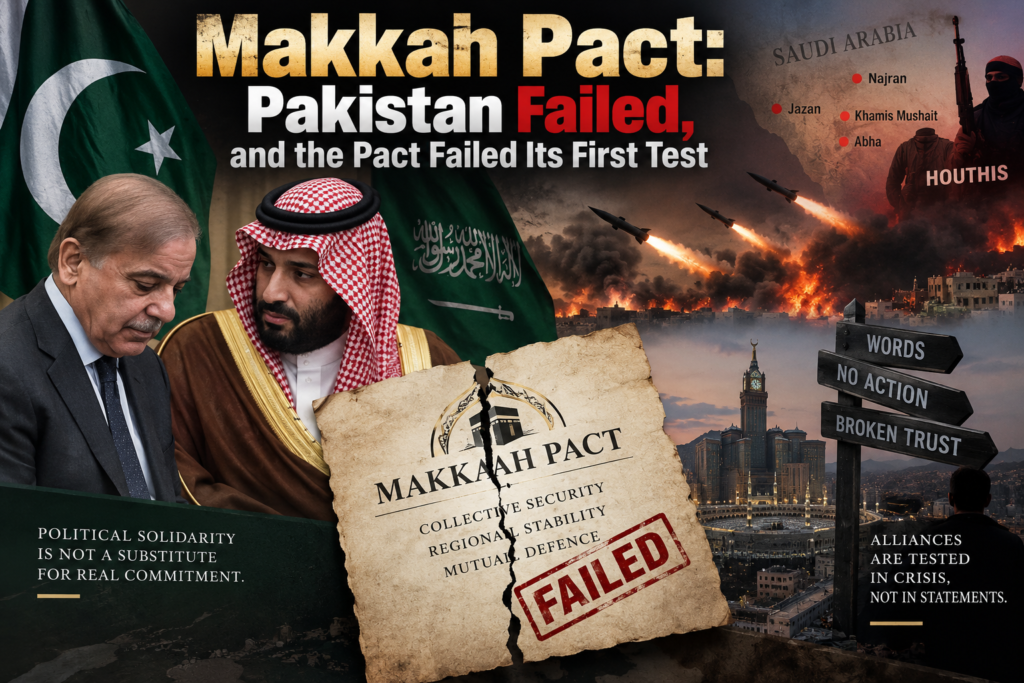
Pakistan’s response to Houthi attacks on Saudi Arabia has exposed a fundamental question over the practical value of the Makkah Pact: how far is Islamabad prepared to go when the security of a partner is directly threatened?
For an agreement presented around the principle that an attack on one member should concern all members, Pakistan’s conduct has so far been notably cautious. Islamabad has condemned the attacks, warned the Houthis that aggression against Saudi Arabia could invoke the pact, and reaffirmed its support for Riyadh. But it has also made clear that no military response is currently under discussion.
That distinction is important. From an Indian geopolitical perspective, the episode highlights the difference between political solidarity and operational collective defence. The former is relatively easy to demonstrate through statements and diplomatic support. The latter requires governments to accept military, financial and political risks.
Saudi Arabia has faced Houthi missile and drone attacks affecting areas including Abha, Khamis Mushait, Jazan and Najran. Pakistan has described some of the attacks as targeting Saudi civilian and economic sites and has publicly condemned them.
On September 8, Islamabad warned the Houthis that an attack on Saudi Arabia could trigger the pact’s collective-defence principle. The statement appeared to give substance to the idea that the security of one member could become a concern for the others.
But Pakistan subsequently clarified that military action was not being discussed.
That qualification has exposed the central ambiguity surrounding the arrangement. If the pact is primarily a political commitment, Islamabad’s response is consistent with a conventional diplomatic posture. If it is intended to function as a genuine collective-defence mechanism, however, the absence of any announced military contribution raises questions about how the commitment would work during a serious conflict.
The issue matters beyond the immediate Houthi crisis because Pakistan has sought to use its relationships with Saudi Arabia and Türkiye to enhance its strategic position. A broader security framework could, in theory, give Islamabad greater diplomatic weight and strengthen its role in the Muslim world.
But alliances do not eliminate national interests. Saudi Arabia, Türkiye and Pakistan each have their own security priorities, economic considerations and regional relationships. None can be assumed to accept unlimited military obligations simply because of political alignment.
Pakistan’s position becomes even more complicated in the event of a wider Saudi-Iran confrontation.
Islamabad shares a border with Iran and has strong reasons to avoid direct military confrontation with Tehran. A decision to fight Iran in defence of Saudi Arabia would carry consequences for Pakistan’s own border security, economy and regional diplomacy.
This is where the Makkah Pact faces its more difficult credibility test. The question is not whether Pakistan supports Saudi Arabia politically. It clearly does. The question is whether Islamabad would accept the costs of military intervention if Saudi Arabia faced a sufficiently serious threat.
So far, the answer remains unclear.
For India, that ambiguity is strategically relevant. Pakistan has traditionally sought political and diplomatic support from friendly Muslim-majority states, particularly when dealing with disputes involving India. But the logic of collective security also imposes obligations on the country seeking such support.
If Pakistan expects partners to stand behind it during a confrontation, those partners can reasonably be expected to examine Islamabad’s own willingness to assume risks on their behalf. A security arrangement based largely on political declarations is unlikely to provide the same deterrent effect as one backed by clearly understood military commitments.
This does not mean that the Makkah Pact has no strategic significance. Defence cooperation, military relationships and political coordination can have value even without automatic troop deployments. But its practical limits become visible when an actual security crisis arrives.
The Houthi attacks have therefore exposed an uncomfortable asymmetry. Pakistan has invoked the collective-defence principle while simultaneously avoiding any commitment to military action. That may reflect a deliberate effort by Islamabad to preserve its relationship with Saudi Arabia without becoming directly involved in another regional conflict.
From a Pakistani perspective, that may be a rational calculation of national interest. From the standpoint of alliance credibility, however, it creates a problem.
The more expansive the language of collective defence, the greater the expectation that members will demonstrate both the capability and willingness to act when another member is threatened. Diplomatic condemnation alone cannot establish that credibility.
The immediate crisis may pass without requiring Pakistan to make that choice. But the question raised by it will remain: when collective security becomes a real military obligation rather than a political declaration, where exactly does Pakistan draw the line?
Until that question has a clearer answer, the Makkah Pact remains stronger as a framework for political and defence alignment than as a demonstrated collective-security guarantee.
Ravish Handoo is a geopolitical analyst, television commentator, and regular participant in television debates on national and international affairs.

Editor
Editor
Share This Article
Facebook Twitter Copy Link Print
Leave a comment

Leave a Reply Cancel reply

Your email address will not be published. Required fields are marked *

House of Texture: Luxury Bed Linen Online
  • Buy Luxury Bed Sheets India
  • Buy Luxury Bed Cover India
  • Buy Luxuury Cushions and Lumbar India
  • Buy Luxury Bedding Set India
  • Buy Kashmiri Embroidered Cushion Cover
  • Buy Electric Blankets India

You Might Also Like

Opinion

When the Battlefield Tests the Brochure: Questions Over Chinese Military Hardware

14 Min Read
Opinion

HOW SECURE IS OUR DEMOCRACY?

16 Min Read
Opinion

The Quiet Change in Jammu and Kashmir Seven Years After Article 370, the Most Meaningful Transformation Is the Return of Ordinary Life

10 Min Read
Opinion

Seven Years After Article 370: A Citizen’s View of a Changing Jammu and Kashmir

10 Min Read

Social Networks

Facebook-f Twitter Youtube

As Seen On

Epilogue
Epilogue
Epilogue
Epilogue

©2024 Epilogue. All Rights Reserved. | Powered by Ideogram Technology Solutions [P] Ltd.

Epilogue
Epilogue
Welcome Back!

Sign in to your account

Lost your password?