

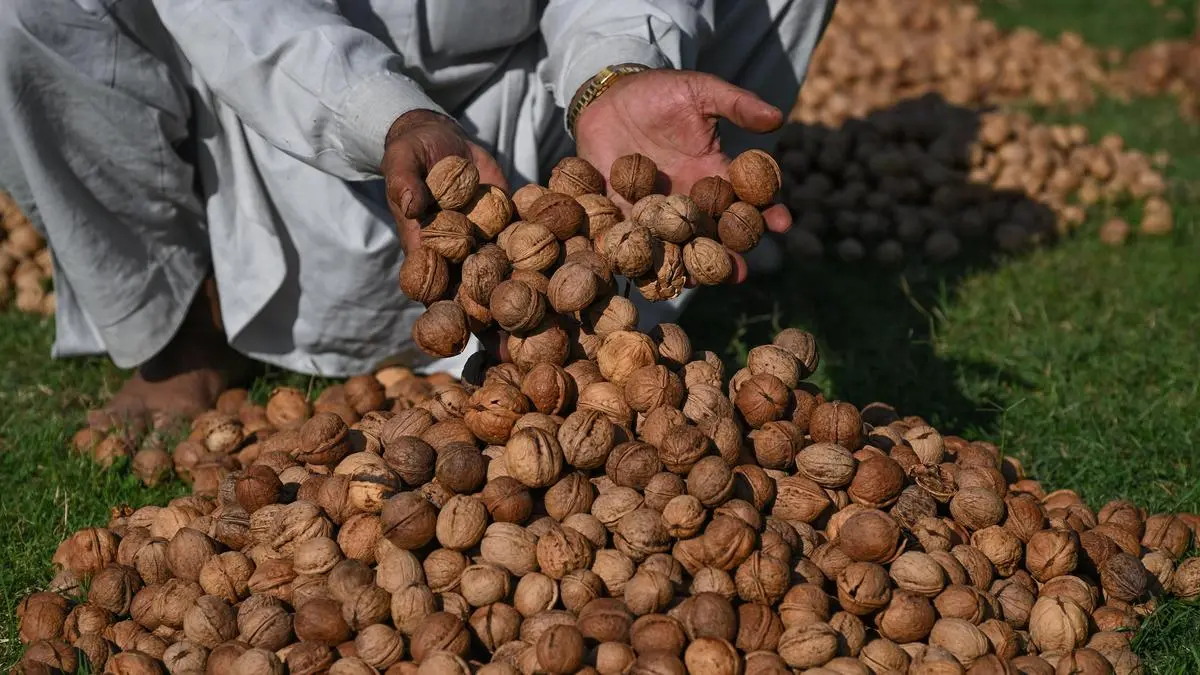

Kashmir’s traditional walnut industry is facing growing challenges, with growers and traders warning that the sector is being pushed towards a serious crisis due to taxation, increasing competition from imported walnuts, inadequate research support and weak market infrastructure. The concerns were raised by the Fruit Association in a representation submitted to Chief Minister Omar Abdullah.
Fruit Association President Haji Bhadur Khan said the 5% GST imposed on walnuts has added to the financial burden on growers and made locally produced walnuts less competitive. He urged the government to reduce the GST to zero per cent to provide relief to farmers and help revive the sector.
The association also expressed concern over the growing availability of walnuts imported from China, Chile and California. According to the growers, cheaper imported varieties, along with their uniform size and competitive pricing, are making it increasingly difficult for Kashmiri walnuts to retain their share in the domestic market.
Growers have called for protective measures, including appropriate restrictions or tariffs on imported walnuts, to safeguard local producers. They also raised concerns over alleged under-valuation of imported walnuts and the possible movement of imported products through alternative routes to avoid taxes.
The Fruit Association has further sought greater investment in research and development. It has called for dedicated walnut research centres, development of high-yielding and disease-resistant varieties, improved kernel quality and technical training for farmers on modern cultivation practices.
Poor market infrastructure is another major concern. The association said important walnut markets, including the Kupwara mandi, require better storage, hygiene, electricity and water facilities. It has urged authorities to modernise these facilities and provide additional space for walnut processing, repacking and business operations.
Growers say immediate government intervention is necessary to make Kashmiri walnuts more competitive and protect the livelihoods of thousands of farming families dependent on the crop. The association has sought a comprehensive package covering GST relief, protection from unfair foreign competition, research support, farmer training and improved market infrastructure.
