


Srinagar: Union Power Secretary Pankaj Agarwal has said that any decision to provide 200 free units of electricity to consumers in Jammu and Kashmir falls within the policy domain of the Union Territory government.
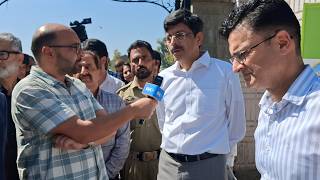
Speaking to reporters during his visit to Srinagar on Saturday, Agarwal was asked whether J&K could introduce a 200-unit free electricity scheme similar to those in some other states. He said such a decision would have to be taken by the UT government.
His remarks come amid discussions over the Jammu and Kashmir government’s plan to provide the benefit to eligible Antyodaya Anna Yojana (AAY) households through rooftop solar systems under the PM Surya Ghar Muft Bijli Yojana.
The Centre has approved the J&K government’s proposal covering around 2.23 lakh AAY families. Under the plan, rooftop solar systems are expected to generate up to 200 units of electricity a month for eligible households.
The scheme is different from providing the first 200 units of grid electricity free to every household. The current proposal is targeted at AAY families and is being worked out through a solarisation model.
The J&K government has been examining the implementation of the scheme through a Renewable Energy Service Company (RESCO) model. The proposed arrangement involves installing rooftop solar systems at the homes of eligible beneficiaries.
The issue has also featured prominently in discussions around electricity policy in the UT. The National Conference had promised 200 units of free electricity during the 2024 Assembly election campaign. The government later moved towards a targeted benefit for economically weaker households.
Agarwal also said there was growing interest from public and private companies in developing solar power infrastructure in Jammu and Kashmir, indicating efforts to expand renewable energy capacity in the region.
For now, the implementation of the 200-unit benefit for eligible AAY households remains tied to the UT government’s policy and execution framework, while the broader question of providing 200 free units to all households would require a separate policy decision.
