

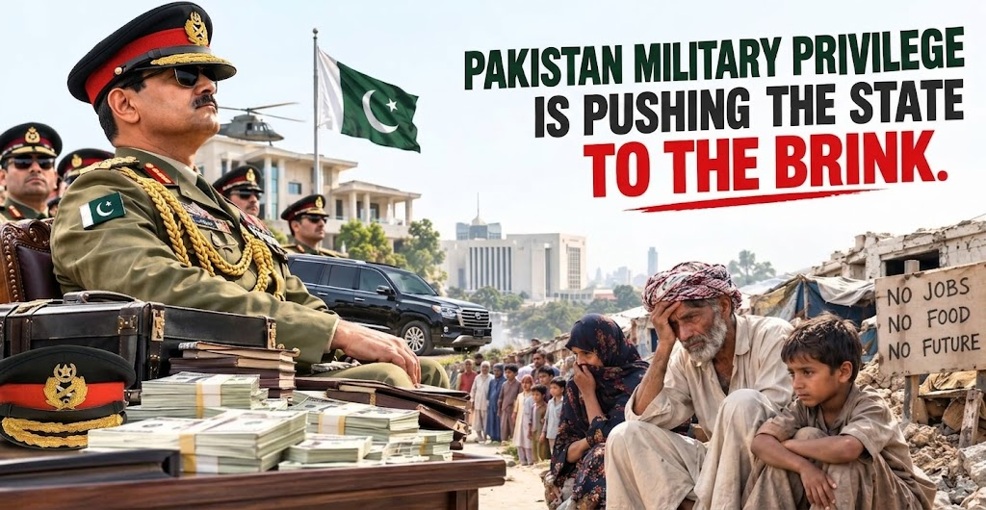

Since its creation in 1947, Pakistan has oscillated between fragile democracy and prolonged military rule, with the armed forces emerging not just as the guarantor of “national security” but as the country’s most powerful economic and political actor. The result is a state where defence priorities consistently crowd out human development and where a vast, opaque military business empire operates beyond civilian oversight. This structural imbalance has played a central role in pushing Pakistan repeatedly to the verge of economic collapse and mass poverty.
Scholar Ayesha Siddiqa in her 2007 book Military Inc.: Inside Pakistan’s Military Economy named the result “Milbus,” military capital controlled by serving and retired officers and insulated from ordinary accountability. Siddiqa argues that Milbus not only entrenches the military’s political dominance but also distorts Pakistan’s economy by diverting public resources, crowding out private enterprise and insulating military elites from civilian oversight – effectively creating a self-sustaining “garrison capitalism” that prioritizes institutional profit over national development
The Coup Cycle and Economic Dislocation
Pakistan’s political history is punctuated by four major military interventions: 1958, 1969, 1977 and 1999. Research on the economic backdrop to these coups shows that GDP growth, export performance and defence spending often deteriorated in the run‑up to takeovers, with the 1958 coup preceded by sharp declines across all key macro indicators. Instead of correcting these imbalances, each military regime entrenched a security‑first economic model, prioritising defence outlays and strategic alliances over institution‑building, tax reform and social spending. Over the long term, this pattern stunted diversified growth and left the economy vulnerable to external shocks, debt traps and recurring balance‑of‑payments crises.
Defence Spending vs Human Development
The budgetary choices tell a stark story. In FY2026‑27, Pakistan raised its defence allocation by 18 per cent to about PKR 3 trillion, even as poverty climbed and debt servicing consumed more than PKR 8 trillion. By contrast, the federal development budget is roughly one‑third of the military allocation, while higher education and healthcare receive only PKR 46 billion and PKR 25 billion respectively. Defence and debt payments together dominate the federal outlay, with defence‑related spending (including pensions) accounting for nearly a fifth of total expenditure and around 3 per cent of GDP in recent years.
By FY2024‑25, the poverty headcount had jumped to 28.9 per cent from 21.9 per cent in FY2018‑19, adding roughly 27 million people to the ranks of the poor and taking the total to around 70 million, even as defence spending was raised by 18 per cent to about PKR 3 trillion in the 2026‑27 budget. World Bank estimates suggest that close to 40-45 per cent of Pakistanis now live below various international poverty thresholds. Empirical work specifically links higher public defence spending to rising poverty in Pakistan, even after controlling for other factors.
The Military’s Commercial Empire
Beyond the formal defence budget lies a sprawling, largely unaccountable commercial network run by serving and retired officers. At its core are four welfare trusts- the Fauji Foundation, Army Welfare Trust, Shaheen Foundation and Bahria Foundation which function as conglomerates rather than charities. The Fauji Foundation alone is estimated to control assets worth tens of billions of dollars, with 23 group companies and six listed entities spanning fertiliser, cement, power, food, banking, insurance, real estate, education and healthcare. Fauji Fertilizer commands a dominant share of the national urea market, while Mari Petroleum supplies a significant portion of Pakistan’s gas output. The Army Welfare Trust runs Askari Bank, Askari Cement and a range of leasing, insurance and real‑estate ventures; together, these entities form what analysts call a “khaki cartel” or “merchant army”
This empire enjoys multiple advantages: preferential access to land and credit, tax concessions, captive markets within the military and veterans’ ecosystem and insulation from civilian audit and parliamentary scrutiny. The result is a parallel economy that diverts talent, capital and policy attention away from competitive, civilian‑led sectors. It also creates powerful vested interests within the officer corps, incentivising the preservation of military privilege and weakening pressure for deep structural reforms in taxation, energy and governance.
Governance, Institutions and the Poverty Trap
The political economy of military privilege has corroded governance in subtle but decisive ways. Frequent interruptions of democratic rule undermined the development of strong political parties, an independent bureaucracy and a credible tax state. Civilian governments, aware of the military’s red lines on defence, foreign policy and internal security, have often avoided confronting the military’s economic footprint. This has produced a fiscal structure where defence and debt service are treated as non‑negotiable, while education, health and social protection remain residual. Pakistan’s tax‑to‑GDP ratio remains among the lowest in the region, limiting the state’s capacity to invest in human capital or cushion the poor during crises.
Poverty, in this context, is not merely a by‑product of bad luck or external shocks; it is structurally embedded. High defence burdens crowd out productive public investment; a powerful military‑industrial complex distorts markets and concentrates wealth and weak institutions fail to deliver basic services or enforce accountability. Rural poverty has surged from 28.2 per cent to 36.2 per cent in recent years, while urban poverty has also climbed sharply, reflecting the erosion of livelihoods and public support systems.
From Security State to Fragile State
The original rationale for military dominance- securing a young, partition‑born state in a hostile neighbourhood has, over decades, mutated into a self‑perpetuating system of privilege. Pakistan’s armed forces have successfully framed themselves as the only “stable” institution in a turbulent polity, yet their economic and political overreach has contributed significantly to the very instability they claim to manage. Repeated near‑defaults, IMF bailouts, double‑digit inflation and surging poverty are the macro‑symptoms of a deeper pathology: a state where the army is both referee and major player in the economy and where civilian governments lack the space, resources and political courage to reorient priorities toward human development.
Unless Pakistan can break this cycle – by bringing military finances under civilian audit, rebalancing budgets toward education, health and social protection and strengthening democratic institutions, the country will remain trapped between a powerful garrison and an impoverished populace. The data since 1947 is unambiguous: military privilege has not secured Pakistan’s future; it has mortgaged it.
