

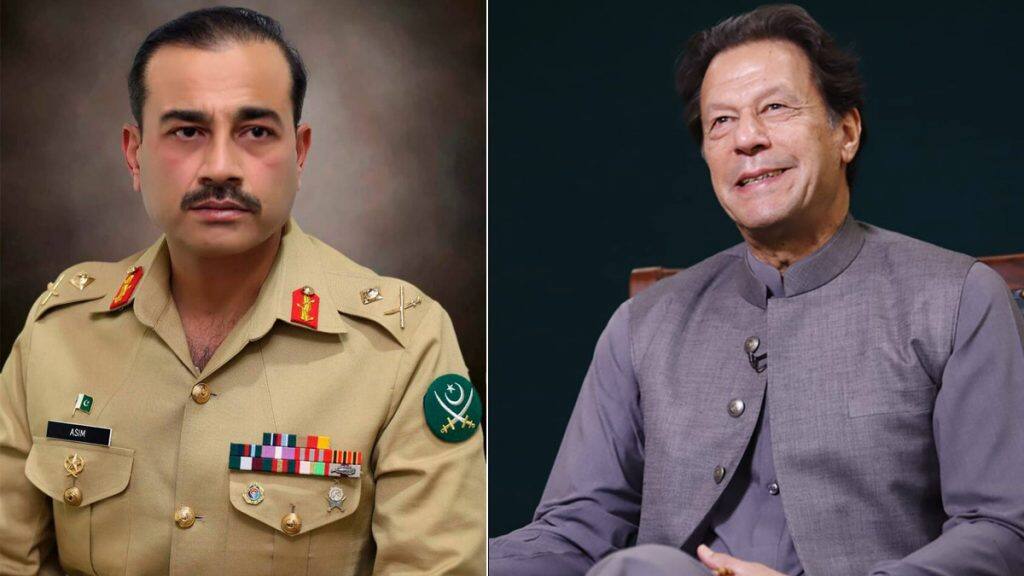

Pakistan’s confrontation with jailed former prime minister Imran Khan is entering another tense phase, with authorities detaining members of his family, restricting access to him and preparing to prevent a planned march on Islamabad, three years after his imprisonment failed to settle the country’s most persistent political power struggle.
Khan’s Pakistan Tehreek-e-Insaf, or PTI, has called for a protest in Islamabad on September 27 to demand his release and challenge restrictions on the party. The government has made clear that the march will not be allowed to proceed, while police preparations include plans to seal major approaches to the capital with shipping containers.
The measures have revived scenes that have become familiar during Pakistan’s recurring political confrontations: containers blocking roads, large police deployments, preventive detentions and restrictions on opposition gatherings.
The latest crackdown has reached Khan’s immediate family. His sister Aleema Khan was detained at her Lahore residence on September 20 ahead of the planned march. His two other sisters, Dr Uzma Khan and Noreen Niazi, were subsequently detained for 30 days under Punjab’s Maintenance of Public Order Ordinance. The detentions have been challenged in court.
Authorities say the measures are necessary to maintain public order. PTI says they are intended to prevent peaceful political mobilisation.
The dispute is the latest chapter in a confrontation that began after Khan’s relationship with Pakistan’s powerful military establishment deteriorated before he was removed as prime minister in a parliamentary no-confidence vote in April 2022.
Khan, once widely regarded as having benefited politically from the military establishment, subsequently became one of its most outspoken critics. The confrontation intensified after his arrest in May 2023 triggered violent protests, including attacks on military installations. Khan has been imprisoned since August 2023 and has faced numerous criminal cases. He denies wrongdoing and has described the cases against him as politically motivated.
His imprisonment has not removed him as a political force.
Candidates aligned with PTI performed strongly in the February 2024 general election despite the party losing its electoral symbol and its candidates contesting as independents. PTI nevertheless failed to form the federal government, leaving Khan incarcerated while his political movement remained a substantial opposition force.
The resulting standoff has evolved into a broader argument over political authority in Pakistan: whether Khan can return to mainstream political life and whether a settlement with the military establishment is possible after years of confrontation.
There have been occasional indications that PTI figures may be willing to lower the temperature. In August, Khan aide Zulfikar Bukhari told Reuters that the former prime minister would not seek confrontation with the army or its chief, Field Marshal Asim Munir, if released. Bukhari presented reconciliation as possible, although Khan himself has repeatedly directed sharp criticism at the military leadership.
No durable accommodation has emerged.
Instead, access to Khan has itself become a political and legal dispute. The Islamabad High Court has ordered that he be permitted meetings with family members, lawyers and party representatives on designated days, but PTI says those directions have repeatedly not been implemented. Party leaders were again denied access to him at Adiala jail this month.
On September 1, the Islamabad High Court directed prison authorities to ensure that Khan and his wife, Bushra Bibi, were not held in solitary confinement and that their treatment complied with prison rules. The government has rejected PTI allegations about Khan’s conditions, saying his detention follows judicial convictions and applicable prison regulations and that he is provided appropriate facilities and security arrangements.
The disagreement has also extended to Khan’s medical treatment. Pakistan’s Supreme Court ordered in August that he be transferred from prison to Shifa International Hospital for treatment. PTI subsequently initiated contempt proceedings after authorities instead took him briefly to the state-run Pakistan Institute of Medical Sciences and returned him to jail. Officials cited security concerns.
For PTI, restrictions on meetings, arrests of activists and family members, and barriers placed in the path of demonstrations have become evidence of what it describes as an effort to marginalise Pakistan’s largest opposition movement.
The government disputes that characterisation and maintains that Khan is imprisoned as a result of judicial proceedings rather than executive detention. It also argues that restrictions surrounding protests are necessary for security and public order.
The use of shipping containers has acquired particular political symbolism. Authorities have repeatedly used them to close roads and restrict access to Islamabad during opposition demonstrations. Ahead of the September 27 march, police have identified major entry points towards Rawalpindi and Islamabad for possible closure, while thousands of personnel are being mobilised.
Yet the deeper dispute cannot be reduced to street protests or Khan’s imprisonment.
Pakistan’s military has exercised considerable influence over national politics for much of the country’s history, both through periods of direct rule and through its role in security, foreign policy and political affairs under civilian governments. Khan’s confrontation with the establishment is unusual partly because a former prime minister once seen as broadly acceptable to the military became the centre of a sustained political movement challenging its influence.
That has left Pakistan with two overlapping conflicts. One is legal and political, centred on Khan’s convictions, imprisonment and PTI’s ability to organise. The other concerns the distribution of power between elected politics and the military establishment.
Neither has been resolved by Khan’s prolonged incarceration.
His imprisonment has restricted his ability to lead PTI directly, while arrests and limits on demonstrations have complicated the party’s efforts to mobilise supporters. But those measures have not eliminated the political constituency surrounding him or settled the argument over the military’s place in Pakistan’s political system.
The September 27 mobilisation is therefore another test of a confrontation that has persisted through elections, court cases, imprisonment and repeated street protests. Whether the march takes place or is prevented, the underlying dispute between Khan’s movement, the civilian authorities and Pakistan’s military establishment remains unsettled.
