

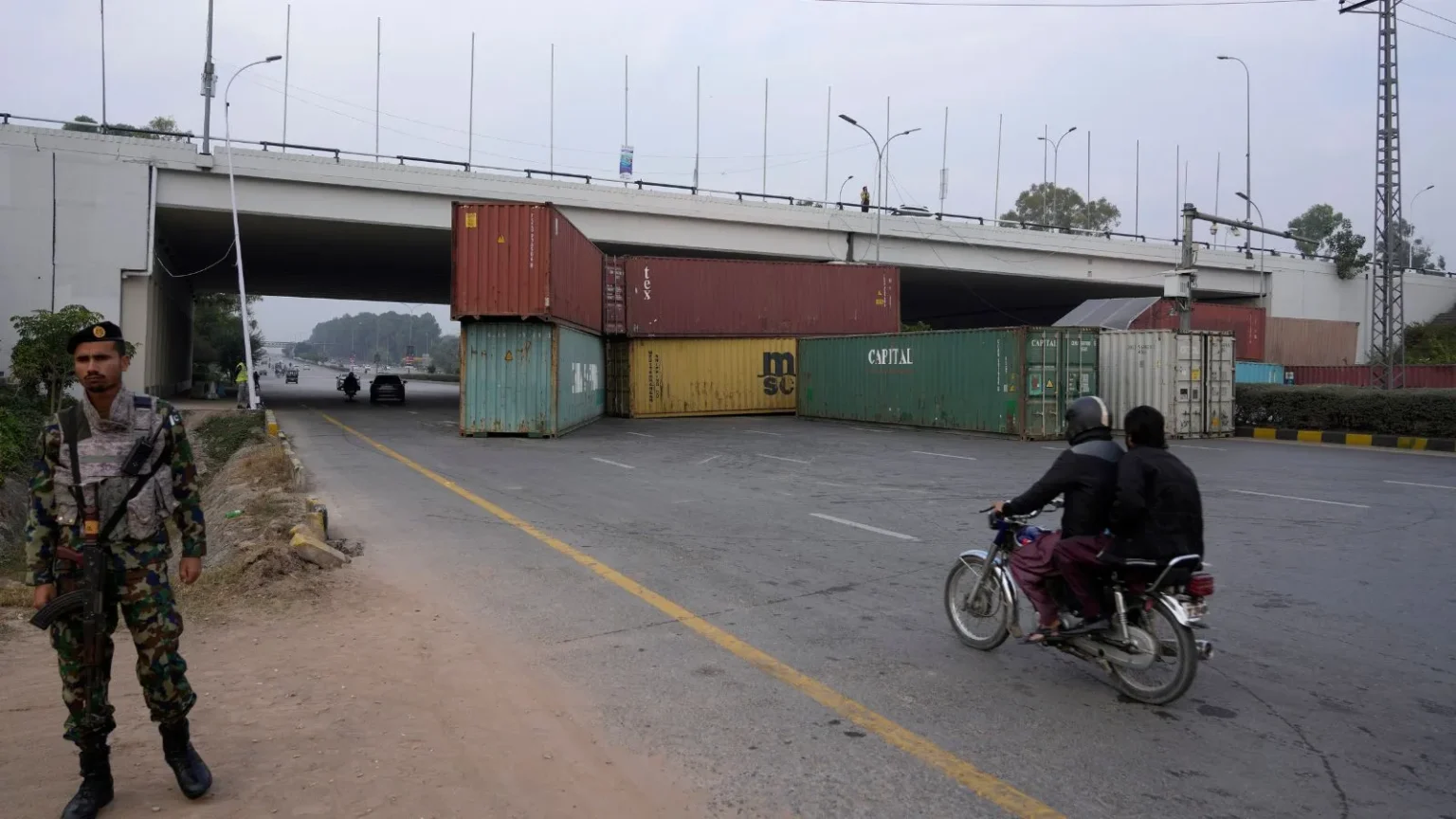

Pakistan has blocked major approaches to Islamabad with shipping containers, deployed thousands of security personnel and detained opposition activists and relatives of former prime minister Imran Khan ahead of a planned September 27 protest, extending a pattern of restrictions on political mobilisation that has drawn criticism from human rights organisations.
By September 24, authorities had placed double-stacked containers and other barriers across highways, intersections and entry points leading to the capital. The Islamabad-Peshawar Motorway was among the routes cut off, while restrictions extended to roads connecting Islamabad with Khyber Pakhtunkhwa, where Khan’s Pakistan Tehreek-e-Insaf, or PTI, governs. AFP reported that about 22,000 security personnel had been deployed.
The measures were imposed before PTI supporters had begun their main march, called to demand Khan’s release from prison. Interior Minister Mohsin Naqvi has said the government will take measures necessary to stop the demonstration. Authorities say the restrictions are required to protect public order and security.
They have already had consequences beyond the opposition movement.
Pakistan’s goods transport industry says police have seized trucks and containers for use as road barriers. The All Pakistan Goods Alliance said at least 2,700 vehicles had been taken into custody in Islamabad, Punjab and other locations, with drivers and helpers also prevented from leaving police stations in many cases. Transport associations had complained about the practice weeks before the protest, arguing that privately owned vehicles should not be commandeered for political crowd-control measures.
The latest operation has also involved preventive detentions.
Khan’s sister Aleema Khan was detained at her Lahore home on September 20 under a 30-day public-order order. His two other sisters, Uzma Khanum and Noreen Niazi, were subsequently detained as the authorities moved against people associated with the planned mobilisation. PTI activists have also been detained.
Amnesty International described the detention of Khan’s family members and PTI activists as arbitrary and said the actions violated rights to liberty, expression, association and peaceful assembly. It also noted that roadblocks were being erected before the September 27 demonstrations.
The government presents a different case. Pakistani authorities have repeatedly argued that restrictions on demonstrations are necessary where protests risk violence, disruption or threats to public safety. Pakistan has previously experienced serious clashes during PTI mobilisations, including the May 2023 violence following Khan’s arrest and the November 2024 confrontation in Islamabad.
That history complicates the argument over where legitimate crowd control ends and suppression of political activity begins.
The physical methods being used this month are not new. Shipping containers have become a recurring feature of political confrontations in Pakistan, allowing authorities to seal highways, bridges and urban intersections quickly. During the November 2024 PTI mobilisation, major routes into Islamabad were barricaded, mobile internet was disrupted and thousands of PTI supporters were detained before and during the protests.
The confrontation subsequently turned deadly. Amnesty International called for an investigation into deaths and injuries and alleged unlawful use of lethal and less-lethal force by security personnel. At least six people, including four security officers, were reported killed, although restrictions on communications and reporting made the full casualty picture difficult to establish.
Open-source material has kept that episode alive in Pakistan’s political debate.
Recent posts reviewed from open sources include a video account attributed to a former Pakistan Army officer identified as Major Imran, who claims he was serving as a company commander at D-Chowk on November 26, 2024, and refused an order to fire on demonstrators. The account says he was subsequently detained and subjected to an army inquiry. The claims are significant if substantiated, but the material circulating on X does not by itself independently establish the full circumstances of the alleged order, and it should therefore be treated as testimony rather than verified fact.
The restrictions surrounding PTI are also part of a broader argument about Pakistan’s legal framework for demonstrations.
The Peaceful Assembly and Public Order Act, enacted in 2024, expanded government powers to regulate or prohibit assemblies in Islamabad and increased penalties for participation in gatherings declared unlawful. Amnesty International criticised the legislation at the time, arguing that its broadly framed provisions could be used to criminalise peaceful protest.
Section 144 of Pakistan’s Code of Criminal Procedure has also repeatedly been used to prohibit gatherings. Amnesty’s review of Pakistan’s human rights record documented restrictions not only against PTI but also against Baloch and Pashtun movements, including arrests, restrictions on rallies and the use of anti-terrorism provisions against activists.
A parallel confrontation has unfolded in Pakistan-administered Jammu and Kashmir, where the Jammu Kashmir Joint Awami Action Committee, or JAAC, has led months of protests over electricity prices, subsidised flour, governance and political representation.
The authorities banned JAAC under anti-terrorism legislation in June. The subsequent unrest involved arrests, communications restrictions, road closures and violent confrontations between demonstrators and security forces.
Material published on by open sources on social media provides a continuing visual record of the movement after the initial crackdown. Footage attributed to Chitra Topi in South Bagh on September 9 shows women, men and children participating in a procession linked to a JAAC protest call. Other posts show a large gathering in Rawalakot and a September 15 torch procession at Chhota Galla after the protest movement had passed the 100-day mark.
Those images are useful evidence that mobilisation persisted despite restrictions. They cannot, on their own, verify broader claims about the political views of the population or allegations surrounding individual incidents.
Earlier BhairavForce material also documented protest caravans assembling in Mirpur for a march towards Muzaffarabad in July. Other posts carried allegations from JAAC activists concerning police actions and raids. As with other conflict-related social-media reporting, those allegations require corroboration before being treated as established facts.
The PTI and JAAC movements have different origins, political objectives and constituencies. They should not be treated as a single campaign. Their experiences nevertheless illustrate similar methods available to Pakistani authorities when faced with large-scale mobilisation: preventive detention, prohibitory orders, road closures, communications restrictions and large security deployments.
The wider pattern extends further. Amnesty International has documented restrictions against the Pashtun Tahaffuz Movement and Baloch activists, including detentions and the use of anti-terrorism legislation. In 2024, it described the restrictions as part of a wider clampdown on peaceful assembly and dissent.
Critics of the government and opposition groups frequently attribute this coercive political environment to Pakistan’s military establishment. The armed forces have historically exercised considerable influence over the country’s politics, but responsibility for specific arrests, road closures and administrative orders cannot automatically be assigned to the military without evidence linking it to individual decisions.
The measures that are documented are substantial enough without making that inference.
Before PTI’s September 27 march has even taken place, highways have been closed, thousands of security personnel deployed, opposition figures detained and commercial vehicles seized for barriers. In Pakistan-administered Kashmir, months of protests have similarly produced arrests, movement restrictions and confrontations with security forces.
Pakistan’s authorities face a legitimate obligation to prevent violence and protect the public during mass demonstrations. The unresolved issue is whether increasingly pre-emptive restrictions are preserving public order or progressively narrowing the practical space in which political opposition and civil movements can exercise the right to peaceful protest.
